Premise 1: Salvation Is by Grace Alone, Not Earned or Progressed Into
Within The Church of Jesus Christ of Latter-day Saints, salvation—especially in its fullest sense—is often understood as something that involves human effort, obedience, ordinances, and continued faithfulness, with grace applied in connection to these conditions. As a result, salvation can appear as a process of progression toward worthiness. Historic Christianity, however, presents a fundamentally different foundation. It teaches that salvation is not achieved, maintained, or completed by human effort, but is entirely the work of God’s grace from beginning to end. The Bible consistently teaches that salvation is a gift of God’s grace, not something earned through obedience or spiritual progression, but granted freely to those who believe as an undeserved act of divine mercy.
The Bible consistently teaches that salvation is a gift of God’s grace, not something earned through human effort, obedience, or spiritual progression. From beginning to end, salvation originates in God’s mercy and is granted freely to those who believe—not as a reward for works, but as an undeserved act of divine kindness.
For by grace are ye saved through faith; and that not of yourselves: it is the gift of God: Not of works, lest any man should boast.”
Ephesians 2:8-9 KJV
In Ephesians 2:8–9, Paul makes this unmistakably clear: salvation is “by grace… through faith… not of works.” This removes any basis for human boasting and establishes that salvation is received, not achieved. Likewise, Romans 4:4–5 contrasts grace and works directly—if salvation were earned, it would be a wage, not a gift. But God “justifieth the ungodly,” declaring righteous those who trust in Him apart from works.
Titus 3:5 reinforces this truth by stating that we are saved “not by works of righteousness which we have done, but according to his mercy.” This excludes not only sinful works, but even our best efforts at righteousness as the basis of salvation.
The consistent testimony of Scripture is that salvation is not a process of becoming worthy, nor a reward for progression into righteousness. It is the gracious act of God toward those who are unworthy—granted fully and freely on the basis of His mercy.
| Passage | Scripture (KJV) |
|---|---|
| Ephesians 2:8–9 | “For by grace are ye saved through faith; and that not of yourselves: it is the gift of God: Not of works, lest any man should boast.” |
| Romans 4:4–5 | “Now to him that worketh is the reward not reckoned of grace, but of debt. But to him that worketh not, but believeth on him that justifieth the ungodly, his faith is counted for righteousness.” |
| Titus 3:5 | “Not by works of righteousness which we have done, but according to his mercy he saved us…” |
| Romans 11:6 | “And if by grace, then is it no more of works: otherwise grace is no more grace…” |
| Galatians 2:21 | “I do not frustrate the grace of God: for if righteousness come by the law, then Christ is dead in vain.” |
| 2 Timothy 1:9 | “Who hath saved us… not according to our works, but according to his own purpose and grace…” |
Salvation is not something we earn, maintain, or progress into—it is a gift of grace given to the undeserving. Any system that makes salvation dependent on human effort undermines the very nature of grace itself.
The Only Way to Earn Salvation Is Perfect, Sinless Obedience
“For I testify again to every man that is circumcised, that he is a debtor to do the whole law.”
Galatians 5:3
In this passage, Paul is warning the Judaizers—those who insisted that Gentile believers must adopt Jewish law (especially circumcision) in order to be fully justified before God. Their teaching was not simply about adding a helpful practice; it was about adding law-keeping as a requirement for salvation.
Paul’s response is decisive. If someone chooses to place themselves under even one aspect of the law as a means of justification, they are obligated to keep the entire law perfectly. The law does not allow partial obedience or selective adherence—it demands complete and flawless conformity. To accept circumcision as necessary for salvation is, in effect, to step into a system where righteousness must be earned in full.
This principle is echoed in James 2:10:
“For whosoever shall keep the whole law, and yet offend in one point, he is guilty of all.”
The point is the same: the law is an indivisible standard. To break even one command is to stand in violation of the whole, reinforcing that justification cannot come through law-keeping, but only through grace.
The Old Testament Affirmed That God’s Holy Standard Is Perfection
Throughout the Old Testament, even the most faithful figures—Abraham, Moses, Noah, Isaiah, and others highlighted in the “Hall of Faith” (Hebrews 11)—are never presented as righteous in themselves. Each of them, in different ways, required atonement for sin. The entire sacrificial system underscores this reality. Year after year, sacrifices were offered because human obedience was never sufficient to meet God’s perfect standard.
Even the high priest, who alone could enter the Holy of Holies on the Day of Atonement, did not come on behalf of the people only. As seen in Leviticus 16:6, he was required to offer sacrifice for himself first, acknowledging that he too stood guilty before God. This demonstrates that no man—not even the most spiritually privileged—could approach God on the basis of his own righteousness.
Scripture makes this explicit. In Isaiah 64:6, God declares that “all our righteousnesses are as filthy rags,” emphasizing that even our best efforts fall far short of His perfect holiness. The language is intentionally strong, underscoring that human righteousness—on its own—is wholly inadequate before a holy God.
This presents a serious question for Latter-day Saint adherents. How can a system grounded in human effort account for a text that so clearly diminishes the value of human righteousness as a basis for acceptance with God—especially when that text predates any supposed “Great Apostasy” by centuries? Even more, this Old Testament testimony aligns seamlessly with the New Testament’s repeated teaching: that justification is not achieved through human works, but rests entirely on the perfect righteousness and finished work of Christ alone.
Latter-day Saint adherents often appeal to the mandate that salvation comes “after all you can do” (2 Nephi 25:23), emphasizing personal effort and obedience. Yet many Latter-day Saints, when asked, acknowledge uncertainty about whether their righteous acts will ultimately be enough, leaving them in a state of ongoing suspense.
In contrast, historic Christianity affirms that salvation does not rest on human effort, but on the finished work of Christ. It is His perfect life and His once-for-all sacrifice on the cross that fully satisfies God’s justice. Because His work is complete, the believer’s confidence is not in what they may achieve, but in what Christ has already accomplished.
Challenge Question: If Scripture consistently teaches—from the Old Testament to the New—that human righteousness cannot satisfy God’s perfect standard, that the law demands flawless obedience, and that even the most faithful required atonement, on what basis can salvation be understood as something earned through personal effort or progression?
Premise 2: Justification Is Immediate and Complete, Not a Process
The doctrine of justification marks a sharp dividing line between historic Christianity and the teachings of The Church of Jesus Christ of Latter-day Saints. In LDS theology, salvation is often described as something received “after all we can do,” with final acceptance before God tied to a lifelong process of obedience, ordinances, and personal righteousness. As a result, justification is not viewed as a once-for-all declaration, but as something progressively realized—and ultimately uncertain—until the end. Scripture, however, presents a fundamentally different picture: justification is not a process to be completed, but a verdict already rendered. It is immediate, complete, and grounded entirely in the finished work of Christ, not in the accumulated efforts of the believer.
The Greek word used for the term Justification in modern translation including the KJV is δικαίωσις (dikaiōsis) which literally means a legal declaration of righteousness. Justification in Scripture is not a gradual transformation but a decisive legal declaration by God. The moment a person places faith in Jesus Christ, God declares that person righteous—not on the basis of their works, but on the basis of Christ’s finished work on the cross.
The apostle Paul the Apostle makes this explicit:
- In Romans 5:1, “having been justified by faith” (past tense), believers already have peace with God.
- In Romans 8:1, “there is now no condemnation for those who are in Christ Jesus.”
- In Romans 8:30, those whom God justifies, He also glorifies—so certain is the verdict that it is spoken as already accomplished.
This justification is immediate—it happens at the moment of faith. It is also complete—nothing can be added to it. Christ’s righteousness is credited (imputed) to the believer fully and finally (cf. 2 Cor. 5:21).
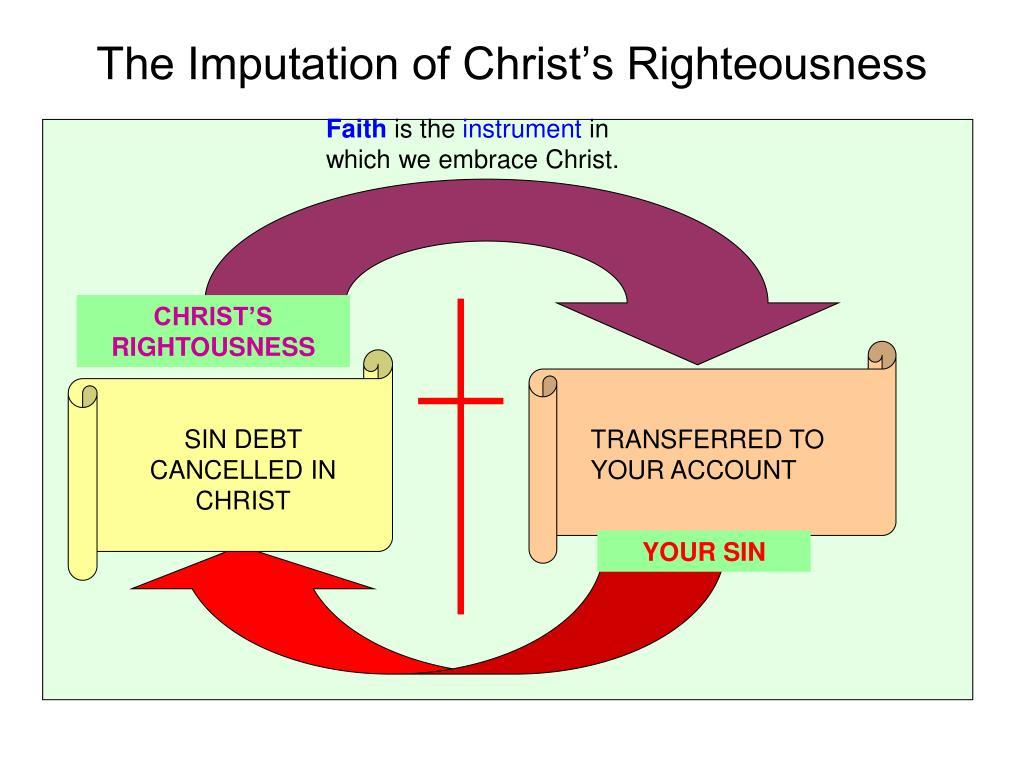
This justification is immediate—it happens at the moment of faith. It is also complete—nothing can be added to it. Christ’s righteousness is credited (imputed) to the believer fully and finally.
Justification Is Immediate and Complete
| Truth | Scripture Text | Reference |
|---|---|---|
| Substitution & Imputed Righteousness | “For our sake He made Him to be sin who knew no sin, so that in Him we might become the righteousness of God.” | 2 Corinthians 5:21 |
| Justified at the Moment of Faith | “Therefore, having been justified by faith, we have peace with God through our Lord Jesus Christ.” | Romans 5:1 |
| No Condemnation Remains | “There is therefore now no condemnation for those who are in Christ Jesus.” | Romans 8:1 |
| Justification Apart from Works | “But to the one who does not work but believes in Him who justifies the ungodly, his faith is counted as righteousness.” | Romans 4:5 |
| Sins Fully Forgiven | “Blessed are those whose lawless deeds are forgiven, and whose sins are covered; blessed is the man against whom the Lord will not count his sin.” | Romans 4:7–8 |
| Declared Righteous by Grace | “And are justified by His grace as a gift, through the redemption that is in Christ Jesus.” | Romans 3:24 |
| Justified by Christ’s Blood | “Since therefore we have now been justified by His blood, much more shall we be saved by Him from the wrath of God.” | Romans 5:9 |
| Saved Through Faith, Not Works | “For by grace you have been saved through faith. And this is not your own doing; it is the gift of God, not a result of works, so that no one may boast.” | Ephesians 2:8–9 |
| Not by Works of Righteousness | “He saved us, not because of works done by us in righteousness, but according to His own mercy…” | Titus 3:5 |
| Perfected for All Time | “For by a single offering He has perfected for all time those who are being sanctified.” | Hebrews 10:14 |
This stands in contrast to any system that treats justification as a process dependent on ongoing works or personal righteousness.
LDS Teaching: Works as a Necessary Component of Salvation & Exaltation
| Source | Quote | Emphasis |
|---|---|---|
| Joseph Smith | “To get salvation we must not only do some things, but everything which God has commanded.” | Total obedience required |
| Brigham Young | “The atonement of Christ… has opened the door for all men to be saved, by obeying the laws and ordinances of the Gospel.” | Salvation tied to obedience + ordinances |
| Spencer W. Kimball | “One of the most fallacious doctrines… is that man is saved alone by the grace of God… Salvation is by grace, but it is earned.” | Grace + effort / earning |
| Spencer W. Kimball | “Exaltation is available only to those who keep all the commandments and who prove themselves worthy.” | Perfection-level repentance |
| Russell M. Nelson | “Salvation is an individual matter; exaltation is a family matter… and is conditional.” | Exaltation conditional |
| Bruce R. McConkie | “Salvation is not obtained merely by confessing the Lord… it comes by obedience to the laws and ordinances of the gospel.” | Obedience required |
| Ezra Taft Benson | “It is not enough for us to be sincere… we must also do the will of the Father.” | Doing required, not belief alone |
| Joseph Fielding Smith | “If we are to gain eternal life, we must obey the commandments of the Lord in all things.” | Commandment-keeping required |
| Bruce R. McConkie | “We are saved by grace after all we can do.” | Effort based salvation |
Scripture consistently separates justification (a one-time declaration) from sanctification (the ongoing process of growth in holiness).Because justification is grounded entirely in Christ’s perfect obedience and substitutionary death, it provides certainty, not suspense. The believer does not hope to be justified someday—they stand justified now. 1 Peter 3:18 explains that the only way for us to get to God is by Christ suffering once for sins—the just in the place of the unjust—to bring us directly to God, accomplishing fully what we could never achieve ourselves.
For Christ also hath once suffered for sins, the just for the unjust, that he might bring us to God
1 Peter 3:18
“That He might bring us to God” means there is no other way to come to Him but through the perfect sacrifice and suffering of Christ for sins. He does not assist us in finishing the work—He accomplishes it. By His death, the barrier of sin is fully removed, and the believer is brought near to God completely and immediately, not progressively or conditionally.
Justification, then, is not a future hope dependent on our performance, but a present reality secured by Christ’s finished work. The cross does not make salvation possible—it makes it certain for those who believe. To suggest that additional effort is required to complete what Christ has already accomplished is to diminish the sufficiency of His sacrifice. Scripture consistently presents a Savior who brings us all the way to God, not part of the way. In Him, the believer stands fully accepted, fully forgiven, and fully justified.
Two men went up into the temple to pray: the one a Pharisee, and the other a publican. The Pharisee stood and prayed thus with himself, “God, I thank thee, that I am not as other men are, extortioners, unjust, adulterers, or even as this publican. I fast twice in the week, I give tithes of all that I possess. And the publican, standing afar off, would not lift up so much as his eyes unto heaven, but smote upon his breast, saying, God be merciful to me a sinner. I tell you, this man went down to his house justified rather than the other; for everyone that exalteth himslef shall be abased; and he that humbleth himself shall be exalted.
Luke 18:10-14
When Jesus, in Luke 18, asked which man went home justified, it was not the Pharisee who trusted in his obedience to the law, but the man who recognized his own sinfulness and cast himself entirely on God’s mercy. In doing so, he stood in full agreement with the truth that all have fallen short before God and that no one can be justified by personal righteousness. His posture reflects the very heart of the Gospel—the “good news” that sinners who could never meet God’s perfect standard have a substitute who did, and who suffered and died because of our sin against that holy standard.
Challenge Question: Why did Jesus say the sinner—not the law-keeper—went home justified, if obedience were the basis of our acceptance?
Premise 3: Good Works Are the Result of Salvation, Not the Cause
Many adherents and leaders within The Church of Jesus Christ of Latter-day Saints are understandably skeptical of a gospel that is not grounded, at least in part, in human effort—because their own doctrinal framework consistently teaches that grace is applied “after all we can do,” requiring obedience, repentance, ordinances, and endurance as conditions for receiving its fullest benefits. As a result, a message of justification that is entirely apart from works can feel incomplete or even irresponsible.
Orthodox Christianity has never taught a doctrine of salvation by grace that fails to produce good works as the fruit of genuine repentance and faith. Rather, it affirms exactly what Jesus taught—that a tree is known by its fruit. The issue is not whether fruit appears, but what kind of tree produces it. A good tree bears good fruit, and a corrupt tree bears corrupt fruit; the nature of the tree determines the outcome.
The key distinction is this: Christians believe that when a person is truly saved by grace, they are not merely improved—they are made new. As John 3:3 teaches, there is a new birth, and as 2 Corinthians 5:17 declares, the believer becomes a new creature. This is not external reform, but internal transformation. Because the nature has changed, the fruit necessarily changes as well.
Jesus answered and said unto him, Verily, verily, I say unto thee, Except a man be born again, he cannot see the kingdom of God. Nicodemus saith unto him, How can a man be born while he is old? Jesus answered, Verily, verily, I say unto thee, Except a man be born of water and of the Spirit, he cannot enter into the kingdom of God. That which is born of the flesh is flesh; and that which is born of the Spirit is spirit.
John 3:3-6
Therefore if any man be in Christ, he is a new creature: old things are passed away; behold, all things are become new.
2 Corinthians 5:17 KJV
Good works, then, are not the means by which a person becomes righteous, but the evidence that they already are. They flow from a new heart, a new nature, and a new life in Christ. The Gospel does not produce fruit by demanding it from an unchanged tree—it produces fruit by making the tree new.
Scripture consistently teaches that good works are the evidence of salvation, not the means of obtaining it. They are the fruit that grows from a life already made alive in Christ, not the root that produces that life. A person is not justified because they do good works; rather, they do good works because they have already been justified.
The apostle Paul the Apostle makes this clear in Ephesians 2:8–10. Salvation is by grace through faith, not of works—yet immediately he explains that believers are created in Christ Jesus unto good works, which God prepared beforehand. Works follow salvation; they do not cause it.
Likewise, James the Just in James 2 is not teaching that works produce justification, but that true faith is demonstrated by works. A faith that produces no fruit is not genuine faith at all. Works are the visible evidence of an inward reality.
Historic Christian Teaching: Good Works Flow From Salvation (Not the Cause)
| Theologian | Quote | Emphasis |
|---|---|---|
| Martin Luther | “Faith alone justifies, but the faith that justifies is never alone.” | True faith produces works |
| John Calvin | “Christ justifies no one whom he does not at the same time sanctify.” | Works follow justification |
| Augustine of Hippo | “Good works follow him who is justified; they do not precede him that is to be justified.” | Works are result, not cause |
| Jonathan Edwards | “Where there is true grace, there is a disposition to the practice of good works.” | Living faith produces fruit |
| John Wesley | “We are justified by faith alone, but not by that faith which is alone.” | Faith necessarily active |
| Charles Spurgeon | “Good works are the fruit, not the root, of salvation.” | Works flow from salvation |
| R. C. Sproul | “We are not justified by faith and works, but by a faith that works.” | Works evidence true faith |
| J. I. Packer | “The moment you have faith in Christ, you are justified; but the faith that saves is a faith that changes you.” | Historic Protestant consensus |
| Thomas Aquinas | “Grace does not destroy nature but perfects it.” | Transformation produces action |
| John Owen | “Though we are not justified by them, yet good works are necessary… as the fruits of faith.” | Necessary as evidence, not basis |
Orthodox Christianity affirms, just as James teaches, that a faith which does not produce good works is dead. True saving faith is never barren—it inevitably bears fruit. At the same time, we maintain that these works are not the basis of our salvation, but the evidence of it. The grace that saves us also enables and transforms us, producing a new life marked by obedience. In this way, good works are not the cause of salvation, but the natural outflow of a heart that has been made alive by grace. Which is exactly what Ephesians 2:8-10 says:
For by grace are ye saved through faith; and that not of yourselves: it is the gift of God: Not of works, lest any man should boast. For we are his workmanship, created in Christ Jesus unto good works, which God hath before ordained that we should walk in them.
Ephesians 2:8-10
When Paul speaks of believers as being “created in Christ,” he is echoing his own teaching in 2 Corinthians 5:17—that those who are saved become a new creation. Salvation is not merely a moral adjustment or external conformity; it is a decisive act of God in which the believer is made new at the deepest level. This transformation is not an isolated New Testament idea—it is the fulfillment of what God had already promised under the New Covenant. The prophets foretold a salvation that would involve a new heart, a new spirit, and an internal work of God that produces obedience.
| Prophecy | What It Says (KJV) | Meaning |
|---|---|---|
| New Heart & New Spirit | “A new heart also will I give you, and a new spirit will I put within you… and cause you to walk in my statutes…” | Ezekiel 36:26–27 |
| Law Written on the Heart | “I will put my law in their inward parts, and write it in their hearts…” | Jeremiah 31:33 |
| New Covenant Promise | “I will make a new covenant… not according to the covenant that I made with their fathers…” | Jeremiah 31:31–32 |
The New Covenant was never about improved external obedience—it was about internal transformation.
God Himself promises to:
- Change the heart
- Indwell His people
- Cause them to walk in His ways
This perfectly aligns with the New Testament teaching that good works flow from a changed nature, not from human effort striving to earn acceptance. The fact that these Old Testament prophecies—preserved in manuscripts that predate the so-called “Great Apostasy” by centuries—so clearly anticipate what New Testament grace is and what it produces should give serious pause not only to LDS adherents, but to any system that teaches good works achieve or even partially contribute to salvation. Rather than supporting such a view, the unified testimony of Scripture—from promise to fulfillment—consistently presents salvation as the work of God that transforms the sinner from within and then produces obedience as its fruit. To reverse this order is not merely to misplace emphasis, but to contradict the very nature of the Gospel itself.
Challenge Question: If both the Old Testament promises and the New Testament fulfillment consistently teach that God Himself transforms the heart and produces obedience, how can good works be the cause of salvation rather than the result of it?
Premise 4: Salvation Does Not Lead To Exaltation Into Godhood
I am He: before Me there was no God formed, neither shall there be after Me.
Isaiah 43:10 KJV
The Church of Jesus Christ of Latter-day Saints, the doctrine of exaltation (that humans can ultimately become like God) is generally understood to be part of the “plain and precious truths” that were lost during what they call the Great Apostasy.
LDS teaching holds that after the death of the apostles, key doctrines and priesthood authority were corrupted or removed from the church. That includes not only authority structures, but also theological ideas—such as:
- the nature of God,
- humanity’s potential,
- and the fullness of salvation (exaltation).
Historic Christianity teaches that salvation restores sinners to a right relationship with God—it does not elevate them into deity. The goal of redemption is not that man becomes God, but that man is reconciled to God, forgiven of sin, and conformed to the image of Christ. Scripture consistently maintains a clear and eternal distinction between the Creator and the creature.
From beginning to end, the Bible affirms that there is only one true God, and that no one will ever become like Him in essence or status. This is not merely a statement about present reality, but about all time—past and future. There has never been, nor will there ever be, another God. Let’s start with the Old Testament:
| Truth (with Reference) | Scripture Text (KJV) | Earliest Manuscript Evidence (Approx. Date) |
|---|---|---|
| God Alone Is God — Isaiah 43:10 | “Ye are my witnesses, saith the LORD… before me there was no God formed, neither shall there be after me.” | Dead Sea Scrolls (Great Isaiah Scroll, 1QIsaᵃ) — c. 125–100 B.C. |
| No God Beside Him — Deuteronomy 32:39 | “See now that I, even I, am he, and there is no god with me…” | Dead Sea Scrolls (4QDeut) — c. 2nd century B.C. |
| The LORD Is One (Shema) — Deuteronomy 6:4 | “Hear, O Israel: The LORD our God is one LORD:” | Dead Sea Scrolls (4QDeut) — c. 2nd century B.C. |
| No Other God Exists — Isaiah 44:6 | “I am the first, and I am the last; and beside me there is no God.” | Dead Sea Scrolls (1QIsaᵃ) — c. 125–100 B.C. |
| God Knows No Other — Isaiah 44:8 | “Is there a God beside me? yea, there is no God; I know not any.” | Dead Sea Scrolls (1QIsaᵃ) — c. 125–100 B.C. |
| God Will Not Share His Glory — Isaiah 42:8 | “I am the LORD: that is my name: and my glory will I not give to another…” | Dead Sea Scrolls (1QIsaᵃ) — c. 125–100 B.C. |
| God Is Eternal — Psalms 90:2 | “Before the mountains were brought forth… even from everlasting to everlasting, thou art God.” | Dead Sea Scrolls (11QPsᵃ) — c. 1st century B.C. |
LDS teaching generally places the onset of the “Great Apostasy” sometime after the deaths of the apostles—often late 1st century to 2nd century A.D. These passages where God in the first person states He alone is God and there was never one before Him and there will never be one after Him pre-date the supposed “Great Apostasy” by an average of 3 centuries.
This creates a significant tension: if the Old Testament already clearly and repeatedly affirms God’s absolute uniqueness centuries before the apostolic era ends, then such teaching cannot reasonably be explained as a later doctrinal loss or removal. Instead, it demonstrates that the biblical foundation of monotheism—one eternal, uncreated God with no others beside Him—was firmly in place well before the timeframe in which the “Great Apostasy” is said to have begun.
The New Testament Reaffirms God’s Eternal Uniqueness and Exclusivity
The New Testament does not introduce a new or altered understanding of God—it confirms and reinforces what was already revealed in the Old Testament: that there is one true and eternal God, and no others will ever exist. Far from softening or expanding this truth, the New Testament writers consistently uphold it in clear and unmistakable terms.
| Scripture (KJV) | Reference |
|---|---|
| “And this is life eternal, that they might know thee the only true God, and Jesus Christ, whom thou hast sent.” | John 17:3 |
| “Thou believest that there is one God; thou doest well: the devils also believe, and tremble.” | James 2:19 |
| “For there is one God, and one mediator between God and men, the man Christ Jesus;” | 1 Timothy 2:5 |
| “For though there be that are called gods, whether in heaven or in earth… But to us there is but one God, the Father, of whom are all things, and we in him…” | 1 Corinthians 8:5–6 |
| “Now a mediator is not a mediator of one, but God is one.” | Galatians 3:20 |
| “One God and Father of all, who is above all, and through all, and in you all.” | Ephesians 4:6 |
| “Seeing it is one God, which shall justify the circumcision by faith, and uncircumcision through faith.” | Romans 3:30 |
| “There is none good but one, that is, God.” | Matthew 19:17 |
| “Now unto the King eternal, immortal, invisible, the only wise God, be honour and glory for ever and ever. Amen.” | 1 Timothy 1:17 |
| “To God only wise, be glory through Jesus Christ for ever. Amen.” | Romans 16:27 |
Jesus Himself affirms this directly. In John 17:3, He identifies the Father as “the only true God,” maintaining the same exclusive language found throughout the Old Testament. Likewise, in Matthew 4:10, Jesus teaches that worship belongs to God alone—echoing the Shema and reaffirming that no other being shares in God’s divine status.
The New Testament does not expand the number of gods or introduce exaltation into deity—it repeats, reinforces, and intensifies the Old Testament’s central claim: There is one God, and He alone is worthy of worship—forever.
What Would Exaltation Imply?
The LDS doctrine of exaltation implies that created human beings, through obedience, can ultimately become gods. But this raises unavoidable questions about what that would actually mean. Would exalted humans then possess the full attributes of deity—able to create worlds, raise the dead, govern the universe at the atomic level, and, as Hebrews 1:3 describes of Christ, “uphold all things by the word of their power”? Would they be omniscient, knowing all things; omnipotent, possessing all power; and omnipresent, present everywhere at once?
These are not secondary qualities—they are the very attributes that distinguish God from His creation. Scripture consistently presents them as unique to God alone, not as qualities that can be attained. To suggest that created beings can acquire these divine attributes is to blur the fundamental and eternal distinction between Creator and creature. The biblical witness, however, maintains that this distinction is never crossed: God alone possesses these attributes, and His creation, though redeemed and glorified, remains forever dependent upon Him.
Challenge Question: How can the LDS doctrine of exaltation be reconciled with the fact that Scripture consistently teaches that God alone possesses the unique attributes of deity—omniscience, omnipotence, omnipresence, and sovereign authority over all creation—and that no other gods will ever exist?